Death in Myth From Osiris to Odin

Updated: Jun 17
Myth Story & Transformation
The oldest stories humanity tells about death are rarely stories about endings alone. Instead, they are journeys into darkness, confrontations with grief, sacrifices for wisdom, and attempts to cross the fragile threshold between worlds. Across continents and centuries, cultures separated by oceans and languages returned again and again to remarkably similar questions: What happens after death? Can death be overcome? What must be surrendered in order to gain meaning? And why do love, transformation, and mortality seem forever intertwined?
Long before psychology, neuroscience, or modern thanatology, myths gave shape to the emotional realities of mortality. They transformed fear into story, ritual, and symbol. Even now, thousands of years later, these myths endure because they are not merely entertaining tales from the distant past. They are symbolic maps for navigating grief, identity, change, and the profound mystery of being human.
Among the great mythic traditions of the world, certain stories stand out for their enduring power. Though they emerge from radically different cultures, the myths of Osiris, Inanna, Odin, Orpheus, and Mictecacihuatl all wrestle with the same truth: death changes everything, yet meaning may still emerge from the encounter.
The Dismembered King: Osiris and the Promise of Continuity

The ancient Egyptian myth of Osiris is one of humanity’s earliest and most influential stories about death and rebirth. Osiris, a divine king associated with fertility and order, is murdered by his jealous brother Set, who dismembers his body and scatters the pieces across Egypt. Isis, (his wife and sister... yah, the gods don't play by the same rules as us mortals), journeys across the land gathering the fragments of his body and reassembling them through devotion, ritual, and magic.
Yet Osiris does not simply “return” in the modern cinematic sense. He is transformed. He becomes ruler of the underworld, lord of the dead, and judge of souls. Death is not annihilation. It is transition into another form of existence.
For the ancient Egyptians, this reflected a cosmic pattern woven throughout nature itself.
The Nile flooded and receded.
Crops died and returned.
The sun descended nightly into the underworld before rising again at dawn.
Proper care of the dead body mattered because identity and spiritual continuity remained tied to ritual remembrance and sacred order.
Osiris reveals one of humanity’s earliest mythic attempts to resist meaninglessness. Even in fragmentation, there remains the possibility of restoration. Even in death, continuity persists.
The Queen Who Descended: Inanna and the Necessary Darkness
The Sumerian story of Inanna’s Descent may be among the most psychologically profound death myths ever recorded. Dating back more than four thousand years, it tells of the goddess Inanna descending into the underworld ruled by her sister Ereshkigal.
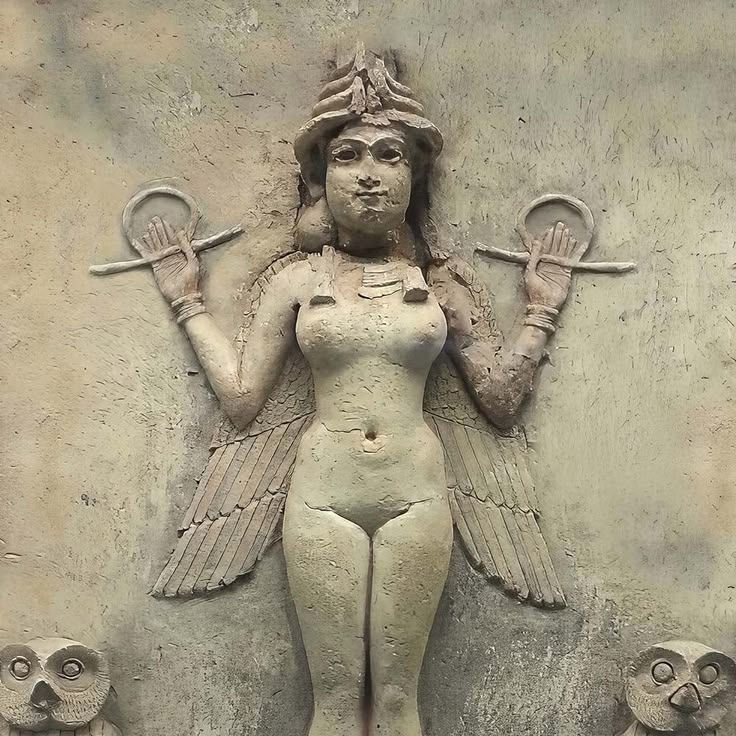
At each of the seven gates leading downward, Inanna is forced to surrender a symbol of identity and power: jewelry, crown, garments, adornments of status. By the time she reaches the deepest realm, she stands stripped bare. There she is judged, killed, and hung upon a hook.
The symbolism is astonishingly raw. Death here is not merely physical cessation. It is ego death. Identity death. The dissolution of certainty, power, and control.
Eventually Inanna is restored and permitted to return, though not without sacrifice and consequence. The descent changes her permanently.
Modern audiences often recognize something profoundly familiar in this myth. Grief, trauma, depression, and major life transitions can feel exactly like this symbolic underworld journey. The old self dissolves. One enters darkness stripped of familiar identities and assumptions. The person who returns is not quite the same as the person who descended.
Unlike modern cultures obsessed with constant productivity and emotional positivity, Inanna’s story suggests that descent itself may hold value. Sometimes transformation requires darkness. Often, the self must be dismantled before something new can emerge.
The God Who Hung Upon the Tree: Odin and the Cost of Wisdom
In Norse mythology, Odin on Yggdrasil presents a very different relationship with death. Odin is not murdered nor dragged unwillingly into darkness. Instead, he sacrifices himself to himself.
According to the myth, Odin hangs upon the great world tree, Yggdrasil, for nine nights. Pierced by his own spear and deprived of food and drink, he remains suspended between life and death until he gains knowledge of the runes, symbols of wisdom, language, and cosmic power.
This is not resurrection mythology in the Egyptian sense. It is initiatory mythology. Nearness to

death becomes the pathway to insight.
Many traditional societies viewed symbolic death experiences as necessary for transformation. Shamans, initiates, and spiritual seekers frequently underwent ordeals meant to dissolve the old self before reintegration into society. Odin’s suffering reflects this ancient understanding that wisdom carries a cost.
The myth speaks to something deeply human. We are the only creatures fully aware of our own mortality, and yet we continue seeking meaning anyway. Odin embodies that paradoxical drive toward understanding despite inevitable death.
The Lover Who Looked Back: Orpheus and the Fragility of Hope
Among the most heartbreaking myths ever told is the Greek story of Orpheus and Eurydice. After the death of his beloved Eurydice, Orpheus descends into the underworld armed only with music and devotion. His song is so beautiful that even Hades is moved to pity. Eurydice may return to the world of the living under one condition: Orpheus must not look back until they have fully emerged from the underworld.

At the final moment, overwhelmed by doubt or longing, he turns.
Eurydice vanishes forever.
Unlike Osiris or Inanna, this myth offers no triumphant resurrection. Love cannot fully conquer death. Some losses remain irreversible.
And perhaps this is precisely why the story continues to resonate so deeply. Modern society often pressures mourners toward “closure” or recovery, as though grief were a temporary disruption to overcome efficiently. Orpheus reminds us that grief is inseparable from love itself. Grief is a descent that transforms us permanently. The backward glance is so relatably human: the aching desire to hold onto someone already disappearing.
His failure is not villainy. It is vulnerability.
The Lady of the Dead: Mictecacihuatl and the Intimacy of Remembrance
In Aztec cosmology, the goddess, Mictecacihuatl (MEEK-tek-ah-see-wah-dl) ruled alongside her husband Mictlantecuhtli (MEEK-tlahn-te-koo-tlee). over Mictlan, the underworld of the dead. Often depicted as a skeletal female figure adorned with symbols of death, Mictecacihuatl can initially appear frightening to modern eyes shaped by Western associations between skeletons and horror. Yet her role was not purely destructive, as she also served as guardian of the dead and

protector of ancestral remembrance.
Scholars widely recognize her as one of the mythological foundations underlying aspects of modern Día de los Muertos traditions, in which the dead are not hidden away in silence but welcomed symbolically back into the community through offerings, altars, flowers, food, music, and memory.
This perspective stands in striking contrast to many modern Western attitudes toward death. Contemporary industrialized societies often sanitize, privatize, and distance death from daily life. The dead are hidden from view, grief becomes isolated, and mourning is expected to resolve quietly and quickly.
Mictecacihuatl represents a different orientation entirely. Death is not severance from community. The dead remain relationally present through ritual remembrance and symbolic reciprocity. Ancestors continue participating in the moral and emotional life of the living.
There is something quite psychologically healthy in this. Human beings appear to be evolutionarily predisposed for continuing bonds with the dead. We keep photographs, preserve heirlooms, revisit stories, and speak to lost loved ones internally long after physical death has occurred. Rather than pathologizing this impulse, traditions surrounding Mictecacihuatl ritualize it openly and communally.
Across all of these myths, death appears not merely as biological cessation, but as transformation, initiation, sacrifice, rupture, remembrance, and continuity. The details differ dramatically, yet each story wrestles with the same essential mystery: how humans create meaning in the face of mortality.
Perhaps this is why these myths continue to endure even within increasingly secular societies. Modern medicine may extend life and science may explain biological processes, yet human beings still hunger for symbolic language capable of expressing grief, awe, fear, and transformation.
These myths persist because they speak in emotional truths rather than literal facts.
In the end, they suggest that death is not solely about endings. It is also about what the living do with endings.
We descend into darkness.
We gather fragments.
We seek wisdom.
We look back.
We honor the dead.
We tell stories.
And through those stories, humanity continues its ancient and profoundly human effort to make meaning from mortality.




Comments