Exploring Love Attachment and Loss Through Creative Expression in Grief

Updated: May 2
February is saturated with love. Hearts, flowers, rituals of devotion, promises of permanence. It is also, less comfortably, saturated with loss.
To love is to attach.
To attach is to risk rupture.
There is no form of deep human connection that does not already carry its opposite within it.
Anthropology has long understood this. Claude Lévi-Strauss argued that human meaning is built through binary oppositions: life and death, presence and absence, self and other, love and loss. We do not experience these as abstract categories. We live them. And when one side of a binary collapses or overwhelms the other, the human mind scrambles to restore balance.
This is where creativity enters the picture, not as decoration, but as mediation.
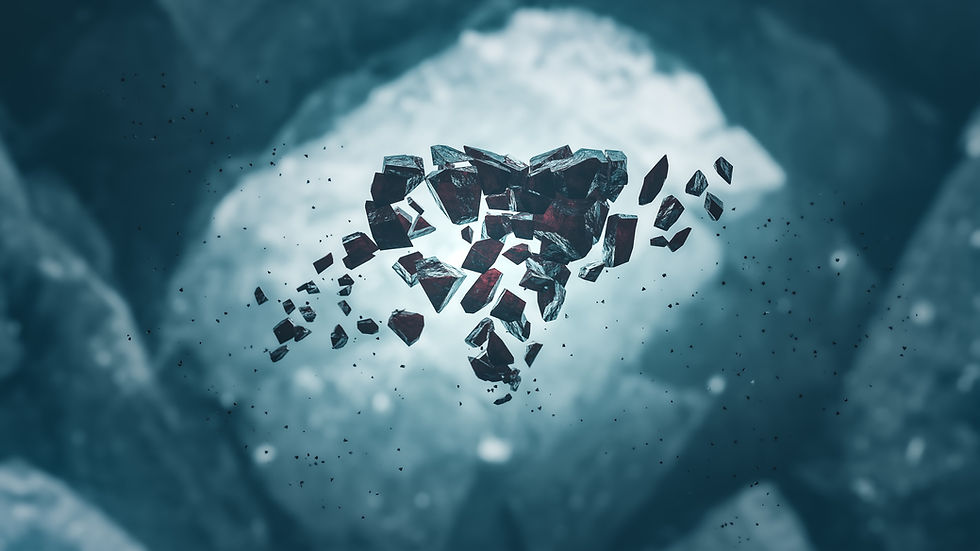
Loss is not simply sadness. It is a structural problem. When an attachment breaks, the familiar oppositions that organize reality stop working. Someone who was present is now absent. A relationship that anchored identity is suddenly gone. Love, which once pointed toward continuity, now points toward finality.
Binary systems do not tolerate unresolved contradiction for long.
So humans make something.
Art does not arrive after loss as a gentle comfort. It appears when the opposition becomes unbearable. When presence turns into absence. When life collides with death. When love no longer has a living recipient.
Creativity functions as a symbolic bridge. It creates a third state where no third state should exist. Not presence, not absence, but representation. Not life, not death, but memory. Not holding on, not letting go, but relationship transformed.
Across cultures, when death disrupts attachment, humans respond by producing mediating symbols. Songs that allow the dead to be addressed. Images that allow the absent to be seen. Objects that hold meaning when bodies no longer can. These forms do not erase the binary. They make it livable.
Lévi-Strauss described myth and symbol as tools that help societies think through contradictions that cannot be resolved in reality. Grief is one of those contradictions. Love does not end simply because a body does. Attachment does not obey mortality’s rules. Creativity allows the impossible to coexist without tearing the psyche apart.
From an evolutionary standpoint, this makes sense. Attachment is foundational to human survival. We bond to regulate fear, share labor, and ensure care across generations. But the very mechanism that allows us to survive guarantees that loss will be devastating. When attachment ruptures, the nervous system searches for coherence, not consolation.
It searches for structure.

It searches for continuity.
It searches for meaning.
That search is creative.
This is why grief so often begins without words. Language is already an abstraction too far. Before explanation comes image. Before narrative comes gesture. Before acceptance comes repetition, rhythm, mark-making. Creativity operates at the level where binaries are still raw and unresolved, where meaning must be constructed, not explained.
In modern Western culture, we often treat creativity as optional. Therapeutic. A helpful coping strategy if you’re inclined that way. In the context of loss, it gets framed as something to do on the path toward “processing” or “moving on.”
But, creativity is not something we add to grief. It is one of the primary ways humans have always processed grief.
When attachment ruptures, art restores balance without denying reality. It allows love to persist without pretending death did not happen. It holds absence in a form that can be encountered, revisited, and slowly integrated.
February invites us to look at love honestly. Not as sentiment, but as structure. Not as romance, but as attachment. And not as something that ends cleanly when a person dies or a relationship changes, but as something that continues to shape us through symbolic life.
Creativity is not a distraction from grief or mortality. It is a human response to contradiction. A way of living inside binaries without being pulled apart by them.
We make because love and loss cannot coexist without mediation.
We make because attachment demands form when bodies are gone.
We make because meaning does not survive rupture unless we build something to carry it.
That is not a coping skill.
That is what humans do when love meets death.


Comments